


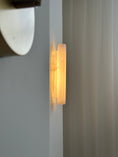
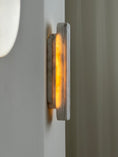
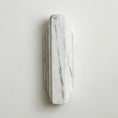
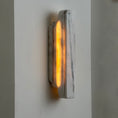
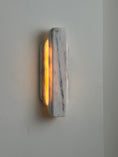
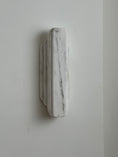
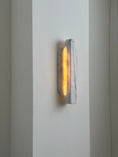
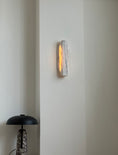
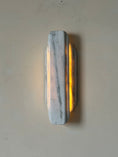

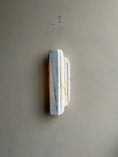
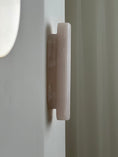
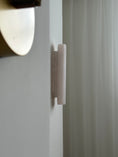


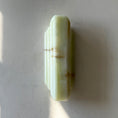
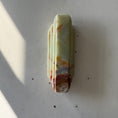
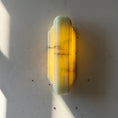
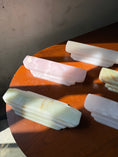
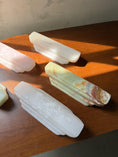
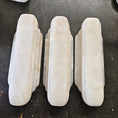


Art Deco Stone Sconce · Natural Onyx & Marble · Integrated LED
A stepped, sculptural wall sconce that pairs solid white Carrara marble with a translucent natural onyx core — the same layered stone logic used in Art Deco interiors of the 1920s, reinterpreted for contemporary proportions. The stepped geometry is machined from solid stone, not cast resin; each tier is individually hand-finished to align perfectly before assembly. When the integrated LED activates, the onyx transmits light through its own veining — every fixture glows with a pattern that belongs to that stone alone.
At 42 cm tall and just 7.5 cm deep, the Jewel Onyx sits flush against the wall with the quiet authority of a built-in architectural detail. It reads as sculpture when off and as a warm, mineral glow when on — equally at home flanking a bed, anchoring a hallway, or marking the entry to a formal living room.
Features
Translucent Stone Core
Natural onyx transmits light through its own veining — each fixture produces a glow pattern unique to its stone.
Art Deco Stepped Form
Machined from solid stone in precise tiers — geometric without being cold, sculptural without being excessive.
Three Light Options
Warm white, cool white, or TRIAC-dimmable warm white — specify at checkout to match your switch setup.
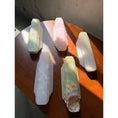
Stone — Choose at Checkout
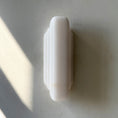
White Marble
Classic Carrara white with fine grey veining. The most restrained option — suits neutral palettes and Scandinavian or transitional interiors.
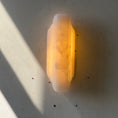
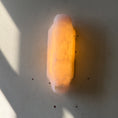
White Natural Onyx
Cream-to-ivory onyx with warm amber undertones. Produces a honeyed, layered glow when lit — the most luminous of the four stones.
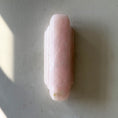
Pink Natural Onyx
Dusty rose to terracotta tones with soft translucency. Warm and distinctive — pairs with warm neutrals, plaster walls, and natural oak.
Green Natural Onyx
Deep sage to forest green with light-catching mineral bands. The boldest choice — dramatic when lit, architectural when off.
Each piece is one-of-a-kind. Natural onyx and marble carry veining, color variation, and translucency that differ from stone to stone. The fixture you receive will not be identical to photographs — that individuality is intrinsic to natural stone, not a defect. If you have a strong preference for lighter or darker veining, note it at checkout and we will do our best to accommodate.
Light Color — Choose at Checkout
Warm White
2700 K
Candlelit warmth. Deepens the amber tones of onyx. Best for bedrooms, living rooms, and intimate settings. Non-dimmable.
Cool White
4000 K
Clean, neutral daylight tone. Brings out the grey veining in white marble and the green depth of green onyx. Non-dimmable.
Warm White Dimmable
2700 K · TRIAC
Same warm tone as above — compatible with standard TRIAC wall dimmer switches. Specify your dimmer brand if possible.
Not sure which light color to choose? Warm White (2700K) is the most popular pairing with onyx — it enhances the stone's natural amber and golden tones. Cool White (4000K) works best with White Marble and Green Onyx where you want contrast rather than warmth. The Dimmable version is the same 2700K warm white but requires a compatible TRIAC dimmer switch — contact us if you are unsure about compatibility.
Specifications
| SKU | RDW-165422 |
| Dimensions | D 15 × W 7.5 × H 42 cm · D 5.9″ × W 3″ × H 16.5″ |
| Weight | 6.3 kg · 13.9 lbs |
| Stone Options | White Marble · White Natural Onyx · Pink Natural Onyx · Green Natural Onyx |
| Light Source | Integrated LED · Non-replaceable · Contact us if service needed |
| Color Temperature | Warm White 2700K · Cool White 4000K · Warm White Dimmable 2700K |
| Dimming | Non-dimmable (Warm & Cool White) · TRIAC-compatible (Dimmable option) |
| Voltage | AC 110–240V · Universal |
| Mounting | Wall sconce · Hardwired · Standard backplate |
| Packing Size | 51 × 25 × 20 cm · 20.1″ × 9.8″ × 7.9″ |
| Best For | Bedrooms · Hallways · Living room accent walls · Dining rooms |
Downloads
FAQ
Which stone should I choose? +
White Marble is the most neutral — works with any palette, produces a cool, elegant glow. White Onyx is the warmest and most translucent — the glow is honeyed and deep, ideal for bedrooms. Pink Onyx adds warmth and color character — pairs naturally with terracotta, plaster, and warm wood. Green Onyx is the most dramatic — the mineral banding is striking when lit, and the stone reads as an architectural element when off.
What's the difference between the three light options? +
Warm White (2700K) produces a candlelit, amber-toned glow — enhances the warmth of onyx stones. Cool White (4000K) is a clean, neutral daylight tone — brings out grey veining in marble and mineral depth in green onyx. Warm White Dimmable (2700K TRIAC) is the same color as Warm White but works with standard TRIAC wall dimmer switches, giving you full brightness control from your existing switch. The Warm White and Cool White versions are non-dimmable and will not work with dimmer switches.
Will my piece look like the photos? +
Not exactly — natural onyx and marble carry unique veining, translucency, and color variation from piece to piece. The glow pattern you see when the light is on will be specific to the stone in your fixture. If you have a preference for lighter or darker veining, or more or less pronounced patterning, leave a note at checkout.
Is installation straightforward? +
Yes — the Jewel Onyx is a standard hardwired wall sconce. It mounts to a standard wall backplate and connects directly to your home's electrical wiring. A licensed electrician is recommended for installation, as with any hardwired fixture. The full installation guide is available for download above.
- Unique shape design
- Made responsibly
- High quality material
- Tested for durability
CARE
CARE
- Dust with a soft, dry cloth.
- To protect finish, we do not recommend the use of household cleaners or abrasives.
- Do not exceed specified wattage.
SHIPPING & RETURN POLICY
SHIPPING & RETURN POLICY
Enjoy free shipping on all products. With Front Door Delivery, your item ships from our Distribution Center via UPS within 2–3 business days and arrives at your home in 4–6 weeks. Eligible items may be returned within 30 days of receipt. Made-to-order items are not eligible for return.
10%
OFF
Use this code at checkout to enjoy a 10% discount on your entire purchase.

The stone that holds
the light.
For eight thousand years, jade has been the material we reserve for what matters most — ritual vessels, imperial seals, the body's most intimate ornaments. Radilum brings that same gravity into lighting. Each fixture in our jade collection is engineered around a single idea: that a lamp should not project light against a room, but appear to contain it.

A stone that refuses to be ordinary.
Jade is the colloquial name for two distinct minerals — nephrite, a calcium magnesium silicate prized in China for over eighty centuries, and jadeite, a sodium aluminium silicate that arrived later from Burma and dominates the modern luxury market. Both share a property no other stone offers in the same measure: a microcrystalline interlocking grain so dense that light, instead of bouncing off the surface, sinks into the stone before re-emerging as a slow, uniform glow.
This is the technical secret behind every fixture on this page. The translucency of fine jade is not a marketing word — it is a measurable optical phenomenon called sub-surface scattering. Photons enter the surface, refract through millions of interlocking microfibres, and exit as diffuse light. There are no hot spots. No glare. No engineered diffuser stands between the LED and your eye. The material itself is the diffuser, and it has been refining that role since the Hongshan culture began carving it in 6,000 BCE.
The Confucian scholar Xu Shen wrote in the second century that jade possesses five virtues: humanity in its warmth, righteousness in its translucency, wisdom in its tone when struck, courage in its refusal to break, and integrity in its sharp edges that do not cut. Two millennia later, those qualities still describe what we look for when we select a block.
The Radilum jade collection is built on the simple recognition that a material with this kind of cultural gravity, this kind of optical character, and this kind of physical permanence has never properly entered the world of contemporary lighting. The fixtures we make are an attempt to correct that.
Four properties that change everything about how a room is lit.
Most lamp materials are chosen for the appearance of the lamp when it is off. Jade is one of the very few that earns its place in the room twice — once as object, and again as light source. The differences come down to four physical properties.
01 Translucent without being thin
Most translucent stones — alabaster, onyx, selenite — achieve their glow by being cut thin. Jade does not need to be. A 6 mm panel of fine Hetian white jade transmits roughly 15% to 22% of incident light, depending on grain orientation. The same panel weighs nearly twice what alabaster of equivalent thickness would. The result is a fixture that looks substantial when off and softly luminous when on — without the fragility that comes with thinner stones.
02 A natural warm-shift filter
Jade selectively absorbs the cooler end of the visible spectrum. A 2700K LED behind a panel of nephrite reaches the eye at roughly 2400K to 2500K — the colour temperature of late-afternoon sun, the colour of incandescent at half power. We design every Radilum jade fixture around this shift, choosing LEDs whose native temperature the stone will pull into the warm zone our customers actually want for living spaces.
03 No two pieces are identical
Every block carries the geological signature of the basin it was cut from — pale clouds, mineral veining, occasional iron pinpoints in the matrix. We grade for these signatures rather than against them. A Radilum Certificate of Origin ships with every fixture, identifying the basin, the block reference, and the technician who polished it. Two clients ordering the same model receive two distinct objects. This is by design.
04 A presence the room can feel even in the dark
Jade is dense — roughly 2.95 g/cm³ for nephrite, 3.30 for jadeite — and slow to change temperature. It feels cool to the hand. It absorbs ambient sound. A jade pendant hanging over a dining table reads as a piece of architecture more than a light source. The lamp is doing two jobs in one.
Six origins. Six different kinds of light.
We do not stock a single jade and call it the brand. The atelier maintains an active library of six principal jade types from four countries — each chosen for the way it transmits, holds, and tints the light passing through it. When a project begins, we send a sample box; the jade is selected before the fixture is.
- BodyIvory
- GlowCream-Warm
- Density2.95 g/cm³
- BodyIvory + Caramel
- GlowHoneyed Amber
- VeiningEach unique
- BodyForest Green
- GlowCool Olive
- PatternBlack flecking
- BodyEmerald / Lavender
- GlowSaturated
- Density3.30 g/cm³
- BodyPale Celadon
- GlowCool Linen
- Best forLarge panels
- BodyCool White
- GlowLinen
- Best forHospitality runs
Beyond the six above, the atelier sources rare material on request — Khotan mutton-fat, Manaoshan red, Guatemalan blue, antique recovered jade. Reach out if a project requires something specific.
Six stages, twelve weeks, one fixture.
A Radilum jade lamp begins life as a 200 kg raw block in a Xinjiang quarry and ends, twelve weeks later, on the ceiling of a project we have spent months understanding. The path between is broken into six controlled stages, each documented with timestamped photographs that ship to the client on completion.

Curated selection at the quarry.
Our material lead spends fourteen days a quarter at the Hetian and Mogok markets. Roughly one block in twelve passes inspection — the rest carry hairline fractures, colour drift, or matrix instability we cannot accept. Selected blocks are scanned, weighed, and matched to specific upcoming projects before they leave the quarry yard.
Light-table inspection & grain mapping.
Each block is sliced into 50 mm test wafers and back-lit on a calibrated light table. We measure transmission percentage, colour-temperature shift, and grain orientation — then map the block in 3D so that subsequent cuts respect the fibre direction. Mis-aligned cuts are the most common cause of weakness in jade objects; we eliminate them at this stage.


Five-axis water-jet, ±0.05 mm tolerance.
The graded block is mounted on a five-axis CNC water-jet station — abrasive garnet suspended in 4,000-bar water. The water cuts without heat, which means the stone never develops the micro-fractures that conventional diamond saws can introduce. Roughing brings the block to within 2 mm of final geometry.
Diamond-tipped sculpting to final form.
Diamond-tipped milling burrs reduce the rough block to within 0.1 mm of the engineering drawing. Curves are interpolated point-by-point. Internal cavities for LED arrays and cable channels are routed at this stage — never drilled later, which preserves the structural grain.


Six grits, two days, one technician.
The signature Radilum surface is a six-stage hand polish — grits 400, 800, 1200, 2000, 5000, and a final felt-wheel buffing with cerium oxide. The whole sequence takes a single technician roughly two working days per fixture. The technician's mark is etched on the fitting.
LED selection matched to your stone.
Because jade selectively warms colour temperature, we cannot specify the LED until the actual block is polished. Each finished panel is back-lit with a tunable test array; we measure the emergent colour temperature and match to a production LED that lands at the target — typically 2700K, sometimes 3000K for hospitality, occasionally 2400K for residential primary suites. The fixture ships with the LED already paired.

Four axes on which any of our work can be modified.
Every fixture in the catalogue is a starting point, not a destination. The atelier handles modifications across four parallel axes — and most projects touch at least two of them. There is no surcharge for the kinds of modifications listed below; we treat them as a normal part of a serious lighting brief.

Form & geometry.
If you can sketch it, the CNC cell can build it — sculptural, geometric, kinetic. Send a hand drawing, a 3D file, an architectural reference, or a mood board. We respond with a polished render in 7–10 working days, no commitment.

Dimensions & scale.
From a residential bedside lamp at 380 mm to a hospitality stairwell installation at 6 m. We work to your architectural dimensions — ceiling height, sight lines, view corridors — not to a fixed catalogue range.

Material selection.
Six jade types in the standard library, with rare material on request. We send physical samples — a 100 mm test panel of every candidate jade — for the project to evaluate against actual room finishes before committing to a material.

Integrated lighting.
Fixed colour temperature (2400K / 2700K / 3000K), tunable white (1800–3500K), full-spectrum tunable RGBW, or smart-home integration via Casambi, Lutron, KNX, or DALI. Driver and protocol specified per project.
Beyond the four standard axes, we customise hardware finish (six brass treatments, blackened or polished steel, custom plating), base materials (travertine, marble, walnut, oxidised bronze), and rigging hardware (cord, chain, rigid stem). Discuss specifics with your project lead.
Three contexts in which jade lighting earns its place.
The Radilum jade collection is overrepresented in three project types — not because it is exclusive to them, but because the material's specific qualities pay back hardest in these environments. Below, what we have learned from the projects we have shipped to.


From first email to final install — one specialist, six weeks.
Every Radilum jade project is led by one project specialist from the day the brief arrives. There is no handover between sales and production. The same person who answers your first email tracks the polishing photos, coordinates the freight forwarder, and follows up on the install. The full timeline below typically runs six to twelve weeks depending on project complexity.
Begin with a brief,
or with a sample box.
Whether you have a single pendant in mind or a whole-house lighting plan, the first step is the same — write to us. The project specialist who reads your email will be the one you work with from the brief through the install. Every email gets a real reply within 24 hours.

Fast Shipping
4-6 weeks for delivery

North American Certification
North American Certification Overview

Safety Payment
Secure payment with Multiple Credit Cards.


Measuring for Pendant Lighting
When installing pendants and chandeliers, it’s important to consider how you want your fixtures to hang in relation to the other furnishings in your space. Read on for our recommendations on how to hang the perfect light.
Kitchen
Aim for 30–36″ from the bottom of your fixture’s shade to the top of your island or countertop. Space multiple pendants 26–30″ apart. For a sense of proportion and balance, allow 12″ from the outermost fixture to the edge of your counter.
Dining Room
For optimal lighting and visibility, the bottom of your pendant should sit 30″ from the surface of your dining table. To scale your fixture, take the length and width of the room in feet, then convert that to inches. For a 10′ by 14′ room, the chandelier should be about 24″ wide.
Bedroom
If you’re hanging a pendant above a nightstand, allow for at least 30″ between the bottom of the shade and your nightstand’s surface. To keep the look balanced, center your pendant over your nightstand.
Size chart
| Size |
| area XS |
| Room XS |
| Size | DIA 2"-6" | DIA 6"-12" | DIA 12"-18" | DIA 20"-24" | DIA 24"-32" | DIA 32"-40" |
|---|---|---|---|---|---|---|
| area | 32-54 FT | 54-107 FT | 107-161 FT | 161-215 FT | 215-269 FT | 269-378 FT |
| Room | BATHROOM/AISLE | DINING ROOM | KITCHEN | BEDROOM | LIVING ROOM | COMMERCIAL INTERIOR |
* Sizes are American and expressed in inches.
