


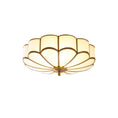




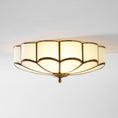
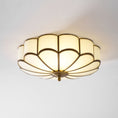
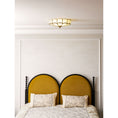
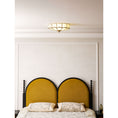
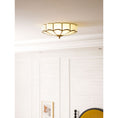
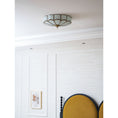
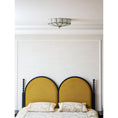
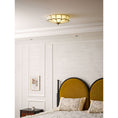
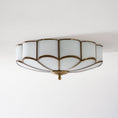
Laiton · Verre Forme Fleur · Plafonnier Postmoderne
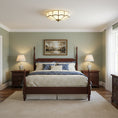
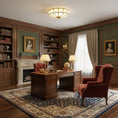
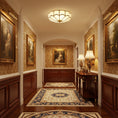
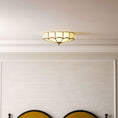
Des pétales de verre sculptés rayonnent depuis une armature centrale en laiton — un luminaire de plafond postmoderne qui sert également de pièce maîtresse discrète. Une lumière douce et diffusée traverse chaque abat-jour en forme de fleur, créant une lueur chaleureuse et tridimensionnelle. Parfait pour les chambres, bureaux, balcons et couloirs.
Voir en action
Aperçu du luminaire
Configuration — À choisir à la caisse
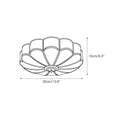
3 Têtes
D 35 × H 16 cm
∅ 13.8″ × H 6.3″
4 têtes
D 45 × H 17 cm
∅ 17.7″ × H 6.7″
6 Bras
D 60 × H 19 cm
∅ 23.6″ × H 7.5″
Finition Métal — À Choisir à la Commande
Or antique chaud — classique et rayonnant.
Blanc mat délicat — épuré, minimaliste, s'harmonise avec les murs clairs.
Matériaux et Fabrication
Armature en laiton
Corps métallique central — le cœur structurel chaleureux d'où rayonnent les abat-jour.
Abat-jour en verre floral
Pétales de verre sculptés — chacun diffuse la lumière pour une lueur tridimensionnelle.
Profil bas de plafond
Positionné près du plafond — idéal pour les chambres, les bureaux et les hauteurs standards.
Notes du Produit
| Dimensions du luminaire | 3 têtes : D 35 × H 16 cm / ∅ 13,8″ × H 6,3″ 4 têtes : D 45 × H 17 cm / ∅ 17,7″ × H 6,7″ 6 têtes : D 60 × H 19 cm / ∅ 23,6″ × H 7,5″ |
| Matériau du corps | Laiton finition affinée |
| Matériau de l'abat-jour | Verre |
| Finitions métalliques | Laiton · Blanc |
| Nombre d'ampoules | 3, 4 ou 6 (selon la configuration) |
| Type de douille | E26 ou E27 base moyenne (Edison) |
| Ampoule incluse | Non — vendue séparément |
| Type de montage | Semi-encastrée · Câblage fixe |
| SKU | RDC-X3028 |
Installation
- Installation au plafond avec câblage permanent — il est recommandé de faire appel à un électricien agréé.
- S'adapte à une boîte de jonction plafond ronde standard. Tout le matériel de montage est inclus.
- Profil semi-encastré — l'appareil s'installe près du plafond (retombée de 16–19 cm selon la configuration).
- Conçu pour les plafonds plats. Non recommandé pour les plafonds inclinés ou voûtés.
- Convient aux emplacements intérieurs secs et humides. Non classé pour les zones mouillées/douches ou l'usage extérieur.
Questions fréquentes
Quelles ampoules recommandez-vous ? +
Ampoules LED culot moyen E26 (Amérique du Nord) ou E27 (UE/Royaume-Uni) blanc chaud (2700K), 4–6W chacune (équivalent ≈40–60W incandescence). Les ampoules globe dépoli ou opale offrent la lueur la plus douce à travers le verre sculpté ; les ampoules à filament clair créent plus d'étincelle et mettent en évidence les formes des pétales.
Quelle configuration devrais-je choisir ? +
La configuration 3 têtes (35 cm / 13,8″) convient aux petites chambres, entrées et balcons. La 4 têtes (45 cm / 17,7″) s'adapte aux pièces moyennes et bureaux. La 6 têtes (60 cm / 23,6″) fonctionne bien dans les plus grandes chambres, couloirs et espaces de vie principaux où vous souhaitez une clarté ambiante plus importante.
Ce luminaire est-il gradable ? +
Le luminaire lui-même est compatible avec la gradation. Appairez des ampoules LED dimmables E26/E27 avec un interrupteur variateur compatible TRIAC (par ex. Lutron, Leviton Decora). Les ampoules standards non-dimmables fonctionneront à pleine luminosité uniquement.
À quelle hauteur de plafond convient-il ? +
Les trois configurations sont semi-encastrées avec une retombée de 16–19 cm, elles conviennent donc à tout plafond standard à partir de 2,4 m (8 ft). Pour les plafonds très bas (moins de 2,4 m), choisissez la configuration 3 têtes plus petite.
Puis-je l'installer sur un plafond incliné ? +
Nous recommandons l'installation sur plafonds plats uniquement. Comme il s'agit d'un montage semi-encastré, la rosace doit être bien plaquée au plafond pour se fixer correctement. Pour les plafonds inclinés ou voûtés, choisissez plutôt un appareil suspendu avec chaîne ou câble.
Comment nettoyer le verre en forme de fleur ? +
Une fois les ampoules refroidies, essuyez délicatement chaque abat-jour en verre avec un chiffon doux non pelucheux. Pour la poussière coincée dans les creux des pétales, utilisez une brosse souple. Pour les taches tenaces, un chiffon humide avec un peu d'eau savonneuse suffit — suivez d'un séchage complet. Évitez les nettoyants abrasifs, qui peuvent rayer le verre ou ternir la finition du métal.
Téléchargements

- Design de forme unique
- Fabriqué de manière responsable
- Matériau de haute qualité
- Testé pour la durabilité
ENTRETIEN
ENTRETIEN
- Dust with a soft, dry cloth.
- To protect finish, we do not recommend the use of household cleaners or abrasives.
- Do not exceed specified wattage.
POLITIQUE D'EXPÉDITION ET DE RETOUR
POLITIQUE D'EXPÉDITION ET DE RETOUR
Enjoy free shipping on all products. With Front Door Delivery, your item ships from our Distribution Center via UPS within 2–3 business days and arrives at your home in 4–6 weeks. Eligible items may be returned within 30 days of receipt. Made-to-order items are not eligible for return.
10%
OFF
Use this code at checkout to enjoy a 10% discount on your entire purchase.


Flower Shape Glass Ceiling Lamp
Twenty to twenty-four panels of opal glass, set in two tiers and held in a hand-formed brass frame, drawn together into a single blooming form. A flush mount that reads as a fixture in the daytime and as a soft lantern at night.

Drawn from a flower, built like a lantern
Each panel is cut to a petal curve and set in two tiers, ten or twelve to a ring, so the seams between them become the design. The brass lines meet at the centre finial, so the lamp looks resolved from every angle in the room.
- Scalloped outlineThe edge softens the rectangle of a ceiling; it suits period rooms and modern ones alike.
- Low profile16–19 cm tall. Works under a 2.4 m ceiling without crowding the space.
- Brass finialA turned drop at the centre finishes the form and hides the fixing.
- Proportion by head count3 heads carry 20 panels (10 + 10); 4 and 6 heads carry 24 (12 + 12). The diameter grows, the petal rhythm stays.
Two materials, chosen to age well
The frame is solid brass strip, not plated steel. The panels are opal glass, not acrylic. Both are materials that look better after ten years than on day one.
 Solid brass
Brass frame
Cut from solid strip, bent by hand to each petal radius and soldered at the joins. Brass does not rust, holds its colour indoors, and can be polished back if you ever want it brighter.
 Opal glass
Opal white glass
Milk-white glass diffuses the bulb into an even glow with no hot spot. It will not yellow, does not scratch like plastic, and wipes clean with a cloth.
Six steps, one pair of hands each
Every lamp crosses six benches in our workshop, and a different pair of hands owns each one. The order never changes; the people have made this lamp hundreds of times.

Pressing the channel
Flat brass strip is run through the press and folded into a U-channel: the groove that will grip each glass edge. Get this wrong by half a millimetre and the panel rattles.

Polishing
Each brass channel is polished on the wheel before it is joined, so every petal edge reads as one clean, continuous line.

Soldering
Channels are cut to length, bent to the petal radius and soldered into two rings, ten or twelve petals each. Every joint is done by hand with a torch, then dressed flush.

Fitting the glass
Opal glass panels are seated into the channels one at a time, and the frame is closed around them. This is the moment the flower takes shape.

Washing
Flux, fingerprints and polishing residue are washed off the finished body so the finish takes evenly and the glass is spotless.

Finishing the brass
The frame is toned by hand to the antique brass colour, sealed, then wired, lit and checked before packing.
Two minutes on the bench
We filmed the lamp being made. No narration; just the sound of brass and glass.


Soft in the evening, quiet by day
Opal glass spreads light across the whole petal, so the ceiling picks up a warm wash rather than a spotlight.
Rooms that ask for it
Flush mounts carry a room's ceiling. This one suits places you pass through often and places you rest in.


Made in batches, finished one at a time
This is one of our most-ordered ceiling lamps. Each batch you see here goes out to homes on three continents.
“Heavier and better made than I expected. The brass has a real depth to it.”Verified buyer · 4-head
“Installed three in the upstairs hall. Guests always ask where they are from.”Verified buyer · 3-head
Three sizes, one silhouette
Match the diameter to the room. A good rule: add the room's length and width in feet, and read the sum as inches of lamp diameter.
A ceiling lamp you will stop noticing, and then miss
Ships in 3–5 days. 30-day returns. Use code RDSHN for 10% off.
Choose your sizeQuestions on fit or wiring? Message us before you order — we answer within a day.

Expédition rapide
4-6 weeks for delivery

Certification nord-américaine
North American Certification Overview

Paiement sécurisé
Secure payment with Multiple Credit Cards.


Measuring for Pendant Lighting
When installing pendants and chandeliers, it’s important to consider how you want your fixtures to hang in relation to the other furnishings in your space. Read on for our recommendations on how to hang the perfect light.
Kitchen
Aim for 30–36″ from the bottom of your fixture’s shade to the top of your island or countertop. Space multiple pendants 26–30″ apart. For a sense of proportion and balance, allow 12″ from the outermost fixture to the edge of your counter.
Dining Room
For optimal lighting and visibility, the bottom of your pendant should sit 30″ from the surface of your dining table. To scale your fixture, take the length and width of the room in feet, then convert that to inches. For a 10′ by 14′ room, the chandelier should be about 24″ wide.
Bedroom
If you’re hanging a pendant above a nightstand, allow for at least 30″ between the bottom of the shade and your nightstand’s surface. To keep the look balanced, center your pendant over your nightstand.