


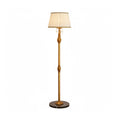
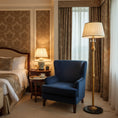



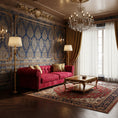


Base de Mármol Negro · Columna de Latón Fundido · Pantalla de Seda Plisada · Belle Époque
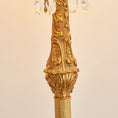
Una lámpara de pie neoclásica en el vocabulario Belle Époque de finales del siglo XIX que definió la iluminación de las mansiones de Newport y las bibliotecas de la Era Dorada — una columna de latón fundido esbelta se eleva desde una base de mármol negro redonda, puntuada por collares de acanto cincelado en el pie, el punto medio y la galería de pantalla. Colgantes de cristal tallado rodean la galería superior, y una pantalla de tambor de seda plisada ceñida corona la columna con luz cálida difusa.
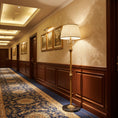
Inspirada en la tradición de las lámparas de biblioteca de la Edad Dorada Americana y la Belle Époque francesa. Ideal para bibliotecas y estudios, áreas de descanso en dormitorios principales, salas de estar formales, vestíbulos de entrada de lujo y suites de hoteles de lujo en propiedades de más de 4,000 pies cuadrados — para clientes amantes del diseño que valoran el vocabulario Federal, Beaux-Arts y Hollywood Regency en interiores transicionales y tradicionales.
Materiales y Confección
Base de Mármol Negro Macizo
Base de mármol negro natural tallada a mano — veteado único en cada bloque, con peso para estabilidad bajo la esbelta columna de latón.
Columna de Latón Fundido y Cincelado
Columna de latón macizo fundido en arena con tres collares de acantos cincelados — ritmo ornamental de Belle Époque históricamente correcto.
Pantalla de Seda Plisada y Cristal Tallado
Cristal tallado cuelga de la galería superior; pantalla de tambor de seda plisada y a medida difunde una cálida luz descendente.
Dimensiones
Tamaño único estándar
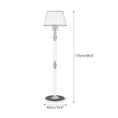
Ø 16.5″ × H 68.9″
Ø 42 × H 175 cm — más cable de enchufe de 59″ (150 cm)
De pie enchufable — sin necesidad de instalación fija. Tipo de enchufe seleccionable al finalizar la compra (US, UK, AU, EU).
Nota Importante — Variación Natural del Mármol
Mármol natural tallado a mano — cada base es única. El patrón de veteado, la profundidad del color y las inclusiones minerales menores varían de bloque a bloque; tu lámpara no coincidirá con las fotos a nivel de mármol.
Especifica tu tipo de enchufe al realizar el pedido. Disponible en US, UK, AU o EU — cableado universal 110–240V. Los envíos con enchufe incorrecto requieren devolución.
Notas del Producto
| Forma | Lámpara de piso Belle Époque · columna esbelta de latón fundido sobre base redonda de mármol negro · cristales tallados en galería superior · pantalla de tambor de seda plisada |
| Material | Base de mármol negro natural tallada a mano · columna de latón macizo fundido y cincelado · cristal tallado · pantalla de tela de seda plisada |
| Acabado | Columna de latón pulido con base de mármol negro y pantalla de seda plisada blanca (acabado estándar único) |
| Dimensiones | Ø 16.5″ × H 68.9″ (Ø 42 × 175 cm) |
| Largo del cable | Cable de enchufe de 59″ (150 cm) que sale de la base |
| Fuente de Luz | Portalámpara de base mediana E26 / E27 — bombillas no incluidas |
| Bombilla Recomendada | E26 / E27 LED, blanco cálido 2700K, equivalente a ≤ 60W incandescente · forma A19 o globo oculta bajo pantalla de seda |
| Regulación | Compatible con interruptores dimmer TRIAC cuando se emparejan con bombillas LED atenuables · Compatible con Lutron |
| Voltaje | CA 110–240V universal · tipo de enchufe seleccionado al finalizar la compra |
| Opciones de enchufe | US · UK · AU · EU — confirma al realizar el pedido |
| Montaje | Pie de piso enchufable · no requiere cableado fijo |
| SKU | RDF-102113 |
| Ideal Para | Bibliotecas y estudios · áreas de descanso en dormitorios principales · salas de estar formales · vestíbulos de entrada de lujo · suites de hoteles y suites presidenciales de lujo · interiores Federal, Beaux-Arts, Belle Époque, Hollywood Regency y tradicionales en propiedades de más de 4,000 pies cuadrados |
| Comercial y Proyectos | Paquetes de especificación para diseñadores, precios comerciales y coordinación de cantidades de proyecto disponibles — póngase en contacto con nuestro departamento comercial |
Instalación
- Instalación enchufable. No se requiere cableado fijo — enchufa en un tomacorriente de pared estándar que coincida con tu tipo de enchufe seleccionado.
- Se requiere manipulación de dos personas. La base de mármol macizo es pesada — desempaca con cuidado, levanta la base de mármol por separado si los componentes se envían desarmados.
- Coloca sobre una superficie estable y nivelada. La base de mármol redonda requiere piso nivelado; se prefiere madera, baldosa o alfombra de bajo pelaje.
- Enrutamiento del cable. El cable de enchufe de 59″ sale de la base — planifica la colocación cerca de un tomacorriente de pared o usa un cable de extensión certificado adaptado a tu región.
- Cuidado: limpia el latón y el cristal con un paño de microfibra suave y seco. Para el mármol, limpia en seco solamente — no uses agua, vinagre ni limpiadores de piedra; el mármol es poroso y se mancha fácilmente.
Descargas
Preguntas frecuentes
¿Dónde se debe colocar esta lámpara? +
Es una lámpara de piso de biblioteca Belle Époque de 68.9″ de alto — ideal para colocar junto a una silla de lectura en dormitorio principal, en una biblioteca o estudio, en una sala de estar formal junto a un sillón de respaldo alto, o como ancla de un arreglo de consola en vestíbulo de entrada. La pantalla de tambor plisada dirige la luz cálida hacia abajo sobre una zona de asiento, lo que la hace muy adecuada como lámpara de lectura junto a fuentes de luz ambiental separadas.
¿Mi pieza coincidirá con las fotografías? +
La columna de latón, los cristales colgantes y la pantalla de seda se fabrican a especificación consistente — tu lámpara lucirá idéntica en forma. La base de mármol negro natural, sin embargo, se talla a mano a partir de bloques individuales: los patrones de veteado, la profundidad exacta del color y las inclusiones minerales menores difieren entre cada base. La lámpara que recibas estará dentro del mismo lenguaje visual que las fotografías pero será visiblemente distinta a nivel del mármol.
¿Qué bombillo debo usar? +
1 × bombilla de base mediana E26 / E27, suministrada por ti. Recomendamos E26 / E27 LED a blanco cálido 2700K, equivalente a ≤ 60W incandescente. La pantalla de tambor plisada oculta la forma del bulbo, por lo que bombillas estándar A19, globo o LED filamento vintage funcionan todas — elige por calidad de color (CRI 90+) para luz de lectura precisa en biblioteca y estudio.
¿Es regulable? ¿Compatible con Lutron? +
Sí — empareja una bombilla LED regulable con un atenuador de pared TRIAC (Lutron Caséta, Diva y atenuadores estándar de fase progresiva funcionan todos). Usa la lámpara en una toma de corriente con interruptor para control de atenuación desde la pared. La lámpara no tiene atenuador integrado.
¿Qué enchufe debo elegir? +
Selecciona US, UK, AU o EU en el carrito para que coincida con tu región de instalación. El cableado interno es universal 110–240V, por lo que la misma lámpara funciona en cualquier mercado una vez que se ajusta el enchufe correcto. Confirma el tipo de enchufe antes de ordenar — los envíos con enchufe incorrecto requieren devolución.
¿Cómo limpio el mármol, latón y cristal? +
Para la base de mármol: limpia solo con un paño de microfibra suave y seco — no uses agua, vinagre ni limpiadores de piedra; el mármol es poroso y se manchará. Para la columna de latón: limpia en seco; para huellas digitales, un paño de microfibra ligeramente humedecido con agua destilada. No uses amoníaco, vinagre ni pulidor de latón comercial — estos opacifican el acabado cincelado. Para los cristales colgantes: limpia suavemente o pasa un paño de microfibra humedecido con agua destilada individualmente; seca inmediatamente. No sumerjas.
- Diseño de forma única
- Fabricado responsablemente
- Material de alta calidad
- Probado para durabilidad
CUIDADO
CUIDADO
- Limpia con un paño suave y seco.
- Para proteger el acabado, no recomendamos el uso de limpiadores domésticos ni abrasivos.
- No excedas la potencia especificada.
POLÍTICA DE ENVÍO Y DEVOLUCIÓN
POLÍTICA DE ENVÍO Y DEVOLUCIÓN
Disfruta de envío gratis en todos los productos. Con Front Door Delivery, tu artículo se envía desde nuestro Centro de Distribución vía UPS en 2–3 días hábiles y llega a tu hogar en 4–6 semanas. Los artículos elegibles pueden devolverse dentro de 30 días de la recepción. Los artículos hechos a medida no son elegibles para devolución.
10%
OFF
Use this code at checkout to enjoy a 10% discount on your entire purchase.

The metal that holds
the light of years.
Brass is the alloy civilisations reach for when they want light to last. Door pulls polished by three generations. Naval instruments still readable a century after the ship was scrapped. Church candelabra that outlive the parish. Radilum's American Brass Collection is built on that same expectation — fixtures forged from H65 cartridge brass, finished by hand, sealed against time, and meant to be the lamp your grandchildren still recognise.

The alloy that refuses to age.
Brass is a copper-zinc alloy whose first known smelting dates to roughly 500 BCE in the eastern Mediterranean — Greek artisans alloying calamine ore with native copper to produce a metal that struck like gold but bent like a tool. By the Roman imperial period, brass was the material of coinage, military fittings, and the household lamps that lit late-republic Rome. Two and a half millennia later it remains, by an enormous margin, the most-used non-ferrous engineering alloy on the planet — and the lighting industry's quiet workhorse.
What makes brass uniquely fit for lighting is a coincidence of properties no single-element metal achieves. Copper gives it warm chromatic depth and the specific red-yellow that reads as luxurious rather than industrial. Zinc hardens the alloy enough to hold sharp turned profiles, threaded fittings, and cast detail without the softness of pure copper or the dullness of grey castings. The blend produces a metal that is workable when you need it to be — and rigid for the next century.
Of the dozen brass grades available to manufacturers, Radilum specifies H65 cartridge brass — 65% copper, 35% zinc. The name comes from its original use: military shell casings, where the metal had to absorb the shock of firing without splitting. That same toughness, applied to a lamp arm, means the part stays dimensionally stable under decades of thermal cycling, hardware tightening, and bulb replacement. Lower-copper alloys (H62, H59) are cheaper but more brittle. We do not use them.
The Radilum brass collection is built on a simple recognition that the wider lighting industry has spent the last two decades forgetting: that the cost difference between a true brass fixture and a brass-plated zinc one is measurable in years of service, not dollars at checkout.
Four properties that change everything
about how a lamp ages.
Most fixture materials are chosen for what the lamp looks like in the showroom photograph. Brass is one of the very few materials that earns its place over the next thirty years. The differences come down to four physical and aesthetic properties.
01 Mass that reads as quality
Solid H65 brass has a density of 8.5 g/cm³ — denser than steel, denser than cast iron, more than three times the weight of zinc-die-cast. A brass sconce of comparable size to a brass-plated zinc one will weigh nearly four times as much. You feel the difference the moment you lift the box. It's not marketing — it's chemistry.
02 Living finish, not a coating
Brass-plated finishes are paint that happens to be metallic. They scratch, chip, and reveal cheaper alloy underneath. Solid brass is the finish — what you see is the metal itself, polished or patinated. A scratch on plated brass is a flaw; a scratch on solid brass is a wear mark that polishes back out. This is why brass instruments survive a century of touring while plated hardware ages out of fashion in five years.
03 Naturally antimicrobial
Copper alloys are oligodynamic — meaning their surface ions disrupt microbial cell membranes on contact. The EPA registers solid brass and bronze as antimicrobial surfaces. A brass switch plate, lamp pull, or door fitting is meaningfully cleaner than the stainless steel equivalent. For high-touch fixtures (bedside lamps, hallway sconces) this matters more than the brochures usually mention.
04 A spectrum the eye reads as warm
Brass reflects light selectively across the visible spectrum — absorbing slightly more blue and green, reflecting more red and yellow. The result is that any light source mounted in or near a brass fixture acquires a faint warm wash. We design the LED specification with this shift in mind: a 2700K bulb behind brass reads as roughly 2550K to the eye, the colour of late-afternoon window light.
Six finishes. Six different conversations
between metal and room.
A single block of H65 can be finished in a dozen ways — and the finish, more than any other variable, decides the personality of the fixture. The atelier maintains six standard characters and adds custom patinas on request. Physical samples are sent before final order on every project of three fixtures or more.
- Reflectivity~85%
- SealantIncralac
- Best forFormal rooms
- Reflectivity~35%
- TextureLinear satin
- Best forMost projects
- ToneAmber to black
- VariationEach unique
- Best forVintage interiors
- Reflectivity~5%
- EdgesBrass glint
- Best forModern luxe
- SealantNone
- PatinaContinuous
- Best forHeritage homes
- PlatingSatin nickel
- BodySolid H65
- Best forCool palettes
The seventeen you can actually order
The six characters above describe how a finish behaves. What you specify is one of seventeen numbered finishes — or a custom patina grown to match a sample you send us.
 01
01 02
02 03
03 04
04 05
05 06
06 07
07 08
08 09
09 10
10 11
11 12
12 13
13 14
14 15
15 16
16 17
17Finishes 01–17 · brass, bronze, iron, steel, nickel, chrome, black · custom patinas matched on request
Order by number, not by name. "Antique brass," "aged brass," "burnished brass" — ask five workshops what those mean and five different metals come back. Finish 04 is the same physical sample in our studio, on the atelier bench, and on your packing list.
And because no screen renders metal honestly, we ship the physical panels before anything is committed. Hold them against your cabinetry and wall paint, at the hour you actually use the room — then send the number.
Color that is grown, not painted on.
A brass finish is not a coat of paint — it is a controlled chemical reaction on the surface of the metal itself. Where a sprayed lacquer sits on top and eventually chips, a true patina is the brass reacting with sulphur, ammonia, or acid salts until its surface ions shift colour. The tone you see is the metal, transformed. That is why a patinated Radilum fixture deepens with age instead of peeling — and why every piece is coloured by hand, one at a time.
Seven stages, ten to twelve weeks,
and nothing exists before you choose.
A Radilum fixture is not pulled from a shelf. It is tooled, cast, polished, patinated and sealed after you order it — which is why the finish can be anything you want, and why the whole thing takes twelve weeks rather than two days.
One project specialist carries the commission from brief to install. There is no handover between sales, design, production and freight; the person who answers your first email is the one who sends you the polishing photographs.
The four stages you will see photographed
Stages three through six happen in the atelier, and each one arrives in your inbox as a timestamped photograph. Not because pictures sell anything — twelve weeks is a long time to trust a workshop on the other side of the world, and a photograph is the only thing that proves what we described actually happened. They come whether or not you ask.

Steel cut from your drawing
The signed-off render becomes a parametric model, then a five-axis tool path, then a steel mould cut in our own shop. Nothing is outsourced here — a tolerance lost at this stage cannot be recovered later.

H65 — the shell-casing alloy
65% copper, 35% zinc: the brass first specified for military cartridges because it absorbs shock without splitting. Every cast piece is annealed so it will not crack a decade from now.

Colour is grown, not sprayed
One technician carries your fixture through every grit, then the patina bath. The reaction is arrested within seconds of reaching tone, and high points are rubbed back by hand. Their mark is etched on the fitting plate.

Multi-layer sealant, tested for 25 years
Three coats of imported Incralac — the conservation lacquer museums use on bronze sculpture. Accelerated-aging tests project 25+ years tarnish-free — or we skip this stage entirely, by request.
The swatch is the cheapest step in the entire commission and the only one that prevents a remake — the finish is the single variable that cannot be corrected once the fixture is built.
Five archetypes — the working portfolio.
Most projects begin from one of five standard categories. Every category scales from intimate residential to full-room hospitality; every category accepts any of the seventeen finishes; every category ships UL-listed for North America (CE/SAA available on request).



Three principles drawn from two centuries
of American interior design.
The Radilum American Brass Collection is shaped by three lineages — Federal-era neoclassical proportion, the early-20th-century Arts & Crafts movement, and the mid-century industrial vernacular. The result is a portfolio that reads as American not because it is decorated with eagles and stars, but because it carries the same restraint and structural honesty that those three traditions share.

Restraint & Proportion
From Federal-era cabinetry: symmetry, balance, restraint. Arms stepped at golden-ratio intervals. Canopies sized to match the column they descend from. Nothing is decorative for decoration's sake. The grandeur is in the proportion, not the ornament.

Structural Honesty
From the Arts & Crafts vocabulary: function expressed, never disguised. Joinery shows. Fasteners are visible and intentional. The arm of a sconce is shaped because it must support a bulb — and that shape is the design. Nothing pretends to be what it isn't.

Classic Shades
From mid-century industrial: opal milk glass, fluted glass, woven linen, perforated metal mesh. Each shade has a hundred-year vocabulary behind it. We pair the shade to the fixture's intended room — not the photographer's preference for what reads on social media.
Begin with a brief, or a finish sample.
Whether you need a single bedside sconce or a hundred matched fixtures for a hospitality build-out, the first step is the same — write to us. The project specialist who reads your email is the one you'll work with from brief to install. Every email gets a real reply within 24 hours.

Envío rápido
4-6 semanas para entrega

Certificación Norteamericana
Descripción general de la certificación norteamericana

Pago Seguro
Pago seguro con múltiples tarjetas de crédito.


Measuring for Pendant Lighting
When installing pendants and chandeliers, it’s important to consider how you want your fixtures to hang in relation to the other furnishings in your space. Read on for our recommendations on how to hang the perfect light.
Kitchen
Aim for 30–36″ from the bottom of your fixture’s shade to the top of your island or countertop. Space multiple pendants 26–30″ apart. For a sense of proportion and balance, allow 12″ from the outermost fixture to the edge of your counter.
Dining Room
For optimal lighting and visibility, the bottom of your pendant should sit 30″ from the surface of your dining table. To scale your fixture, take the length and width of the room in feet, then convert that to inches. For a 10′ by 14′ room, the chandelier should be about 24″ wide.
Bedroom
If you’re hanging a pendant above a nightstand, allow for at least 30″ between the bottom of the shade and your nightstand’s surface. To keep the look balanced, center your pendant over your nightstand.
Tabla de tamaños
| Tamaño |
| área XS |
| Sala XS |
| Tamaño | DIÁ 2"-6" | DIÁ 6"-12" | DIÁ 12"-18" | DIÁ 20"-24" | DIÁ 24"-32" | DIÁ 32"-40" |
|---|---|---|---|---|---|---|
| área | 32-54 FT | 54-107 FT | 107-161 FT | 161-215 FT | 215-269 FT | 269-378 FT |
| Sala | BAÑO/PASILLO | COMEDOR | COCINA | DORMITORIO | SALA DE ESTAR | INTERIOR COMERCIAL |
* Los tamaños son estadounidenses y se expresan en pulgadas.
