


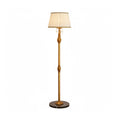



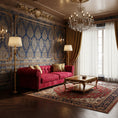


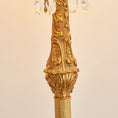
Zwart marmerbasement · Gegoten koperen zuil · Geplooide zijden kap · Belle Époque
Een neoklassieke vloerlamp in de laat-19de-eeuwse Belle Époque-woordenschat die de verlichting in Newport-herenhuizen en Gilded Age-bibliotheken definieerde — een slanke gegoten koperen zuil rijst op uit een rond zwart marmerbasement, geaccentueerd door gechased acanthusfragmenten bij de voet, het middelpunt en de kapgalerij. Geslepen-kristallen hangers omringen de bovenste galerij, en een verzorgde geplooide zijden trommelvormige kap bekroont de zuil met diffuus warm licht.
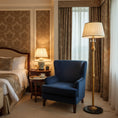
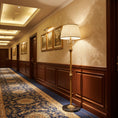
Geïnspireerd door de Amerikaanse Gilded Age en de Franse Belle Époque-bibliotheekamlamp-traditie. Geschikt voor bibliotheek- en studeervertrekken, zithoeken in de slaapkamer, formele zitruimten, formele ingangsfoyers en luxe hotelsuites in landhuizen van 4.000+ m² — voor design-georiënteerde klanten aangetrokken tot de Federal-, Beaux-Arts- en Hollywood Regency-woordenschat in transitional en traditional interieurs.
Materialen & Vakmanschap
Solide zwart marmerbasement
Met de hand gesneden natuurlijk zwart marmerbasement — de adersing is uniek per blok, gewicht voor stabiliteit onder de slanke koperen zuil.
Gegoten & gechased koperen zuil
Zandgegoten massieve koperen zuil met drie gechaste acanthusfragmenten — period-correcte Belle Époque sierornamenten.
Geslepen kristal & geplooide zijden kap
Geslepen-kristallen hangers omringen de bovenste galerij; verzorgde geplooide zijden trommelvormige kap verspreidt warm downward-licht.
Afmetingen
Enkele standaardmaat
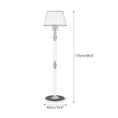
Ø 16.5″ × H 68.9″
Ø 42 × H 175 cm — plus 150 cm snoer
Insteekbare staande lamp — geen hardwiring nodig. Stekkertype geselecteerd bij checkout (US, UK, AU, EU).
Let op — natuurlijke marmerafwijking
Met de hand gesneden natuurlijk marmer — elk basement is uniek. Adersing, kleurdiepte en kleine mineraleninclusies variëren per blok; uw lamp zal op marmerniveau niet overeenkomen met de foto's.
Geef uw stekkertype op bij bestelling. US, UK, AU of EU beschikbaar — universele 110–240V bedrading. Verkeerde stekker-zendingen vereisen terugzending.
Productgegevens
| Vorm | Belle Époque vloerlamp · slanke gegoten koperen zuil op rond zwart marmerbasement · geslepen-kristallen hangers bij bovenste galerij · geplooide zijden trommelvormige kap |
| Materiaal | Met de hand gesneden natuurlijk zwart marmerbasement · zandgegoten en gechased massieve koperen zuil · geslepen kristal · geplooide zijden stofkap |
| Afwerking | Gepolijste koperen zuil met zwart marmerbasement en witte geplooide zijden kap (enkele standaard afwerking) |
| Afmetingen | Ø 42 × H 175 cm |
| Snoerlengte | 150 cm snoer afgaande bij sokkel |
| Lichtbron | E26 / E27 medium-basis fitting — gloeilampen niet inbegrepen |
| Aanbevolen gloeilamp | E26 / E27 LED, 2700K warm wit, ≤ 60W gloeilampeequivalent · A19 of bolachtige vorm verborgen door zijden trommel |
| Dimmen | Compatibel met TRIAC dimmerschakelaars in combinatie met dimmbare LED-lampen · Lutron-compatible |
| Spanning | AC 110–240V universeel · stekkertype geselecteerd bij afrekenen |
| Stekkeropties | US · UK · AU · EU — bevestig bij bestelling |
| Montage | Stekkeruitvoering · geen hardwiring nodig |
| SKU | RDF-102113 |
| Geschikt voor | Bibliotheek- en studeervertrekken · zithoeken in slaapkamers · formele zitruimten · formele ingangsfoyers · luxe hotelsuites en presidentiële suites · Federal-, Beaux-Arts-, Belle Époque-, Hollywood Regency- en traditional interieurs in landhuizen van 4.000+ m² |
| Handel & Projecten | Ontwerpspecificatiepakketten, handelsprijzen en coördinatie voor projecthoeveelheden beschikbaar — neem contact op met ons trade desk |
Installatie
- Plug-in installatie. Geen hardwiring vereist — sluit aan op een standaard wandcontactdoos die uw geselecteerde stekkertype matcht.
- Twee personen nodig voor montage. Solide marmerbasement is zwaar — voorzichtig uitpakken, het marmerbasement afzonderlijk tillen als componenten los verstuurd zijn.
- Plaats op een stabiel vlak oppervlak. Het ronde marmerbasement vereist vlakke vloering; hardhout, tegels of laagpolig tapijt aanbevolen.
- Snoerrouting. Het 59″ voedingssnoer komt uit aan de basis — plaats het licht in de buurt van een stopcontact of gebruik een gecertificeerde verlengsnoer die geschikt is voor uw regio.
- Onderhoud: stof het messing en kristal af met een zachte, droge microvezelstofkap. Voor het marmer: alleen droog afstoffent — geen water, azijn of steenreinigingsmiddelen gebruiken; marmer is poreus en vlekt gemakkelijk.
Downloads
Veelgestelde vragen
Waar dient deze lamp te staan? +
Het is een Belle Époque bibliotheek-design staande lamp van 68,9″ hoog — ideaal geplaatst naast een leesstoel in de slaapkamer, in een bibliotheek of studeerkamer, in een formele zithoek naast een fauteuilstoel, of als anker van een consolebladcompositie in de entree. De geplooid zijden cylinder richt warm licht naar beneden over een zitzone, waardoor het perfect geschikt is als leeslamp, aangevuld met afzonderlijke omgevingsverlichting.
Zal mijn lamp overeenkomen met de foto's? +
De messing kolom, kristallen hangers en zijden kap zijn naar consistente specificatie vervaardigd — uw lamp ziet er identiek uit in vorm. De natuurlijke zwarte marmeren basis wordt echter handmatig uit individuele blokken gesneden: aderingspatronen, exacte kleurdiepte en kleine minerale insluitsels verschillen bij elke basis. De lamp die u ontvangt valt binnen dezelfde visuele taal als op de foto's, maar zal op marmerniveau duidelijk uniek zijn.
Welke gloeilamp moet ik gebruiken? +
1 × E26 / E27 medium-fitting gloeilamp, door u geleverd. Wij adviseren E26 / E27 LED op 2700K warm wit, ≤ 60W gloeilampequivalent. De geplooid zijde cylinder verbergt de gloeilaamvorm, dus standaard A19, bol of vintage gloeidraad LED werken allemaal — kies voor kleurkwaliteit (CRI 90+) voor nauwkeurig licht voor bibliotheek en studeerkamer.
Is het dimbaar? Lutron-compatibel? +
Ja — combineer een dimbare LED-lamp met een TRIAC wanddimmer (Lutron Caséta, Diva en standaard forward-phase dimmers werken allemaal). Gebruik de lamp op een geschakeld stopcontact voor wandbediening van het dimmen. De lamp zelf heeft geen ingebouwde dimmer.
Welke stekker moet ik kiezen? +
Selecteer bij afrekenen VS, VK, AU of EU om uw installatiegebied aan te passen. Interne bedrading is universeel 110–240V, dus dezelfde lamp werkt in elk land zodra de juiste stekker is aangepast. Bevestig het stekkertype voordat u bestelt — verzendingen met verkeerde stekker vereisen terugzending.
Hoe reinig ik het marmer, messing en kristal? +
Voor de marmeren basis: uitsluitend afnemen met een zachte droge microvezeldoek — gebruik geen water, azijn of steenreiniger; marmer is poreus en kan vlekken. Voor de messingkolom: droog afnemen; voor vingerafdrukken een microvezeldoek voorzichtig bevochigd met gedestilleerd water. Gebruik geen ammonia, azijn of commerciële messingpolijst — deze doven de gechaprineerde afwerking. Voor de kristallen hangers: voorzichtig afnemen of individueel afvegen met een microvezeldoek bevochigd met gedestilleerd water; onmiddellijk drogen. Niet onderdompelen.
- Uniek vormontwerp
- Verantwoord gemaakt
- Materiaal van hoge kwaliteit
- Getest op duurzaamheid
ONDERHOUD
ONDERHOUD
- Stoffen met een zachte, droge doek.
- Om de afwerking te beschermen, raden we het gebruik van huishoudelijke schoonmaakmiddelen of schuurmiddelen niet aan.
- Overschrijd de opgegeven wattage niet.
VERZEND- EN RETOURBELEID
VERZEND- EN RETOURBELEID
Geniet van gratis verzending op alle producten. Met Front Door Delivery wordt uw item vanuit ons distributiecentrum via UPS verzonden binnen 2–3 werkdagen en komt het thuis aan in 4–6 weken. In aanmerking komende artikelen kunnen binnen 30 dagen na ontvangst worden geretourneerd. Op maat gemaakte artikelen komen niet in aanmerking voor retournering.
10%
OFF
Use this code at checkout to enjoy a 10% discount on your entire purchase.

The metal that holds
the light of years.
Brass is the alloy civilisations reach for when they want light to last. Door pulls polished by three generations. Naval instruments still readable a century after the ship was scrapped. Church candelabra that outlive the parish. Radilum's American Brass Collection is built on that same expectation — fixtures forged from H65 cartridge brass, finished by hand, sealed against time, and meant to be the lamp your grandchildren still recognise.

The alloy that refuses to age.
Brass is a copper-zinc alloy whose first known smelting dates to roughly 500 BCE in the eastern Mediterranean — Greek artisans alloying calamine ore with native copper to produce a metal that struck like gold but bent like a tool. By the Roman imperial period, brass was the material of coinage, military fittings, and the household lamps that lit late-republic Rome. Two and a half millennia later it remains, by an enormous margin, the most-used non-ferrous engineering alloy on the planet — and the lighting industry's quiet workhorse.
What makes brass uniquely fit for lighting is a coincidence of properties no single-element metal achieves. Copper gives it warm chromatic depth and the specific red-yellow that reads as luxurious rather than industrial. Zinc hardens the alloy enough to hold sharp turned profiles, threaded fittings, and cast detail without the softness of pure copper or the dullness of grey castings. The blend produces a metal that is workable when you need it to be — and rigid for the next century.
Of the dozen brass grades available to manufacturers, Radilum specifies H65 cartridge brass — 65% copper, 35% zinc. The name comes from its original use: military shell casings, where the metal had to absorb the shock of firing without splitting. That same toughness, applied to a lamp arm, means the part stays dimensionally stable under decades of thermal cycling, hardware tightening, and bulb replacement. Lower-copper alloys (H62, H59) are cheaper but more brittle. We do not use them.
The Radilum brass collection is built on a simple recognition that the wider lighting industry has spent the last two decades forgetting: that the cost difference between a true brass fixture and a brass-plated zinc one is measurable in years of service, not dollars at checkout.
Four properties that change everything
about how a lamp ages.
Most fixture materials are chosen for what the lamp looks like in the showroom photograph. Brass is one of the very few materials that earns its place over the next thirty years. The differences come down to four physical and aesthetic properties.
01 Mass that reads as quality
Solid H65 brass has a density of 8.5 g/cm³ — denser than steel, denser than cast iron, more than three times the weight of zinc-die-cast. A brass sconce of comparable size to a brass-plated zinc one will weigh nearly four times as much. You feel the difference the moment you lift the box. It's not marketing — it's chemistry.
02 Living finish, not a coating
Brass-plated finishes are paint that happens to be metallic. They scratch, chip, and reveal cheaper alloy underneath. Solid brass is the finish — what you see is the metal itself, polished or patinated. A scratch on plated brass is a flaw; a scratch on solid brass is a wear mark that polishes back out. This is why brass instruments survive a century of touring while plated hardware ages out of fashion in five years.
03 Naturally antimicrobial
Copper alloys are oligodynamic — meaning their surface ions disrupt microbial cell membranes on contact. The EPA registers solid brass and bronze as antimicrobial surfaces. A brass switch plate, lamp pull, or door fitting is meaningfully cleaner than the stainless steel equivalent. For high-touch fixtures (bedside lamps, hallway sconces) this matters more than the brochures usually mention.
04 A spectrum the eye reads as warm
Brass reflects light selectively across the visible spectrum — absorbing slightly more blue and green, reflecting more red and yellow. The result is that any light source mounted in or near a brass fixture acquires a faint warm wash. We design the LED specification with this shift in mind: a 2700K bulb behind brass reads as roughly 2550K to the eye, the colour of late-afternoon window light.
Six finishes. Six different conversations
between metal and room.
A single block of H65 can be finished in a dozen ways — and the finish, more than any other variable, decides the personality of the fixture. The atelier maintains six standard characters and adds custom patinas on request. Physical samples are sent before final order on every project of three fixtures or more.
- Reflectivity~85%
- SealantIncralac
- Best forFormal rooms
- Reflectivity~35%
- TextureLinear satin
- Best forMost projects
- ToneAmber to black
- VariationEach unique
- Best forVintage interiors
- Reflectivity~5%
- EdgesBrass glint
- Best forModern luxe
- SealantNone
- PatinaContinuous
- Best forHeritage homes
- PlatingSatin nickel
- BodySolid H65
- Best forCool palettes
The seventeen you can actually order
The six characters above describe how a finish behaves. What you specify is one of seventeen numbered finishes — or a custom patina grown to match a sample you send us.
 01
01 02
02 03
03 04
04 05
05 06
06 07
07 08
08 09
09 10
10 11
11 12
12 13
13 14
14 15
15 16
16 17
17Finishes 01–17 · brass, bronze, iron, steel, nickel, chrome, black · custom patinas matched on request
Order by number, not by name. "Antique brass," "aged brass," "burnished brass" — ask five workshops what those mean and five different metals come back. Finish 04 is the same physical sample in our studio, on the atelier bench, and on your packing list.
And because no screen renders metal honestly, we ship the physical panels before anything is committed. Hold them against your cabinetry and wall paint, at the hour you actually use the room — then send the number.
Color that is grown, not painted on.
A brass finish is not a coat of paint — it is a controlled chemical reaction on the surface of the metal itself. Where a sprayed lacquer sits on top and eventually chips, a true patina is the brass reacting with sulphur, ammonia, or acid salts until its surface ions shift colour. The tone you see is the metal, transformed. That is why a patinated Radilum fixture deepens with age instead of peeling — and why every piece is coloured by hand, one at a time.
Seven stages, ten to twelve weeks,
and nothing exists before you choose.
A Radilum fixture is not pulled from a shelf. It is tooled, cast, polished, patinated and sealed after you order it — which is why the finish can be anything you want, and why the whole thing takes twelve weeks rather than two days.
One project specialist carries the commission from brief to install. There is no handover between sales, design, production and freight; the person who answers your first email is the one who sends you the polishing photographs.
The four stages you will see photographed
Stages three through six happen in the atelier, and each one arrives in your inbox as a timestamped photograph. Not because pictures sell anything — twelve weeks is a long time to trust a workshop on the other side of the world, and a photograph is the only thing that proves what we described actually happened. They come whether or not you ask.

Steel cut from your drawing
The signed-off render becomes a parametric model, then a five-axis tool path, then a steel mould cut in our own shop. Nothing is outsourced here — a tolerance lost at this stage cannot be recovered later.

H65 — the shell-casing alloy
65% copper, 35% zinc: the brass first specified for military cartridges because it absorbs shock without splitting. Every cast piece is annealed so it will not crack a decade from now.

Colour is grown, not sprayed
One technician carries your fixture through every grit, then the patina bath. The reaction is arrested within seconds of reaching tone, and high points are rubbed back by hand. Their mark is etched on the fitting plate.

Multi-layer sealant, tested for 25 years
Three coats of imported Incralac — the conservation lacquer museums use on bronze sculpture. Accelerated-aging tests project 25+ years tarnish-free — or we skip this stage entirely, by request.
The swatch is the cheapest step in the entire commission and the only one that prevents a remake — the finish is the single variable that cannot be corrected once the fixture is built.
Five archetypes — the working portfolio.
Most projects begin from one of five standard categories. Every category scales from intimate residential to full-room hospitality; every category accepts any of the seventeen finishes; every category ships UL-listed for North America (CE/SAA available on request).



Three principles drawn from two centuries
of American interior design.
The Radilum American Brass Collection is shaped by three lineages — Federal-era neoclassical proportion, the early-20th-century Arts & Crafts movement, and the mid-century industrial vernacular. The result is a portfolio that reads as American not because it is decorated with eagles and stars, but because it carries the same restraint and structural honesty that those three traditions share.

Restraint & Proportion
From Federal-era cabinetry: symmetry, balance, restraint. Arms stepped at golden-ratio intervals. Canopies sized to match the column they descend from. Nothing is decorative for decoration's sake. The grandeur is in the proportion, not the ornament.

Structural Honesty
From the Arts & Crafts vocabulary: function expressed, never disguised. Joinery shows. Fasteners are visible and intentional. The arm of a sconce is shaped because it must support a bulb — and that shape is the design. Nothing pretends to be what it isn't.

Classic Shades
From mid-century industrial: opal milk glass, fluted glass, woven linen, perforated metal mesh. Each shade has a hundred-year vocabulary behind it. We pair the shade to the fixture's intended room — not the photographer's preference for what reads on social media.
Begin with a brief, or a finish sample.
Whether you need a single bedside sconce or a hundred matched fixtures for a hospitality build-out, the first step is the same — write to us. The project specialist who reads your email is the one you'll work with from brief to install. Every email gets a real reply within 24 hours.

Snelle verzending
4-6 weken voor levering

Noord-Amerikaanse certificering
Overzicht Noord-Amerikaanse certificering

Veilige Betaling
Veilige betaling met meerdere creditcards.


Measuring for Pendant Lighting
When installing pendants and chandeliers, it’s important to consider how you want your fixtures to hang in relation to the other furnishings in your space. Read on for our recommendations on how to hang the perfect light.
Kitchen
Aim for 30–36″ from the bottom of your fixture’s shade to the top of your island or countertop. Space multiple pendants 26–30″ apart. For a sense of proportion and balance, allow 12″ from the outermost fixture to the edge of your counter.
Dining Room
For optimal lighting and visibility, the bottom of your pendant should sit 30″ from the surface of your dining table. To scale your fixture, take the length and width of the room in feet, then convert that to inches. For a 10′ by 14′ room, the chandelier should be about 24″ wide.
Bedroom
If you’re hanging a pendant above a nightstand, allow for at least 30″ between the bottom of the shade and your nightstand’s surface. To keep the look balanced, center your pendant over your nightstand.
Groottetabel
| Maat |
| oppervlakte XS |
| Ruimte XS |
| Maat | DIA 2"-6" | DIA 6"-12" | DIA 12"-18" | DIA 20"-24" | DIA 24"-32" | DIA 32"-40" |
|---|---|---|---|---|---|---|
| oppervlakte | 32-54 FT | 54-107 FT | 107-161 FT | 161-215 FT | 215-269 FT | 269-378 FT |
| Ruimte | BADKAMER/GANG | EETKAMER | KEUKEN | SLAAPKAMER | WOONKAMER | COMMERCIEEL INTERIEUR |
* Afmetingen zijn in Amerikaanse inches.
