


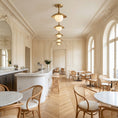
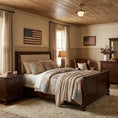
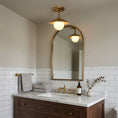
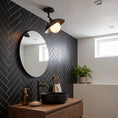
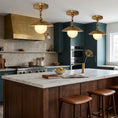
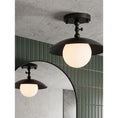
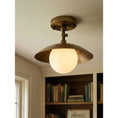


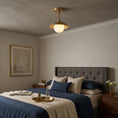
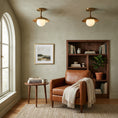
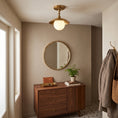
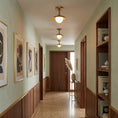
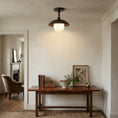
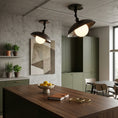
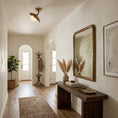
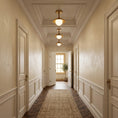
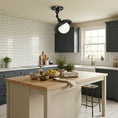


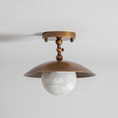
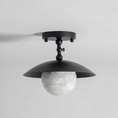
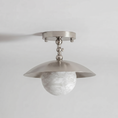
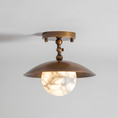
Brass Dome · Opal Glass or Alabaster · Semi Flush Mount
A hand-finished brass dome cradles a smooth white opal globe — clean mid-century geometry that reads both vintage and contemporary. The semi-flush profile keeps ceilings uncluttered while letting the fixture sit proud of the plane. A quiet, bright statement for hallways, bedrooms, kitchens, and entryways.
Please Note: Each piece features unique natural veining.
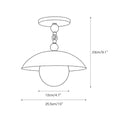
Dimensions
Metal Finish — Choose at Checkout
Warm hand-finished brass — softens and deepens over time.
Matte charcoal — graphic contrast against the white shade.
Shade Material — Choose at Checkout
Smooth, uniform glass — clean modern diffusion with an even glow.
Natural stone with subtle veining — warm, organic, one-of-a-kind character.
Both shades are white but read very differently — opal glass is clean and uniform; alabaster is natural stone with visible veining and tonal variation between pieces.
Materials & Craft
Brass Dome
Hand-finished brass canopy — the defining mid-century silhouette.
Two Shade Options
Choose at checkout — White Opal Glass for clean diffusion, or White Alabaster Stone for warm, natural depth.
Adjustable Angle
Lamp body tilts to direct light exactly where you need it.
Product Notes
| Fixture dimensions | D 25.5 × H 23 cm / ∅ 10″ × H 9.1″ |
| Shade diameter | 12 cm / 4.7″ |
| Canopy diameter | 12 cm / 4.7″ |
| Body material | Hand-finished brass |
| Shade material | White glass or White alabaster |
| Metal finishes | Antique Brass · Black · Nickel color |
| Socket type | G9 |
| Bulb included | No — sold separately |
| Mount type | Semi flush · Hardwired |
| SKU | RDC-194812 |
Installation
- Hardwired ceiling installation — a licensed electrician is recommended.
- Fits a standard round ceiling junction box. All mounting hardware is included.
- The 12 cm canopy fully covers a standard junction box footprint.
- Designed for flat ceilings. Not recommended for sloped or vaulted ceilings.
- Suitable for indoor dry and damp locations. Not rated for wet/shower zones.
FAQ
How do I choose between opal glass and alabaster? +
White Opal Glass is the clean, modern choice — uniform colour, smooth surface, even diffusion. Best for contemporary interiors and rooms where you want consistent, anonymous light. White Alabaster Stone is the natural, characterful choice — every piece has unique veining and subtle tonal gradient, and the stone glows from within when lit. Best for warm, considered interiors where you want the fixture itself to be a quiet conversation piece. Both are white at first glance but read very differently in person.
Which bulb do you recommend? +
A G9 LED bulb at 3–6W in warm white (2700K) gives the softest, most flattering light through both the opal glass and alabaster shades. The fixture accepts up to 60W per bulb, so most G9 LEDs work comfortably. Avoid cool-white or daylight bulbs — they can look clinical against the white shade and flatten the alabaster's natural veining.
Is this fixture dimmable? +
The fixture itself is compatible with dimming. To dim it, pair a dimmable G9 LED bulb with a TRIAC-compatible dimmer switch (e.g. Lutron, Leviton Decora). Standard non-dimmable bulbs will run at full brightness only.
What ceiling height does it suit? +
With a total drop of 19 cm, the fixture sits close to the ceiling and suits most standard rooms from 2.4 m (8 ft) upward. Because it's semi-flush rather than pendant, it won't hang low enough to feel intrusive in halls, bedrooms, or kitchens.
Can I install it on a sloped ceiling? +
We recommend installation on flat ceilings only. On a sloped or vaulted ceiling, the canopy will not sit flush and the fixture may not mount securely. Choose a pendant or sloped-ceiling-adapter fixture for angled surfaces.
Is it safe to use in a bathroom? +
Yes — for dry and damp bathroom zones (e.g. the ceiling above a vanity or mirror, away from direct spray). It is not rated for installation directly above a shower or tub where steam and water contact are constant.
How do I clean the shade? +
Wait until the bulb is cool, then choose by material: Opal glass — wipe with a soft, lint-free cloth; for stubborn marks, use a damp cloth with mild soapy water and dry thoroughly. Alabaster stone — dust with a soft dry cloth only; avoid water, soap, and any cleaner, as alabaster is porous and can absorb moisture and stain. Avoid abrasive cleaners on the brass finish.
Downloads
- Unique shape design
- Made responsibly
- High quality material
- Tested for durability
CARE
CARE
- Dust with a soft, dry cloth.
- To protect finish, we do not recommend the use of household cleaners or abrasives.
- Do not exceed specified wattage.
SHIPPING & RETURN POLICY
SHIPPING & RETURN POLICY
Enjoy free shipping on all products. With Front Door Delivery, your item ships from our Distribution Center via UPS within 2–3 business days and arrives at your home in 4–6 weeks. Eligible items may be returned within 30 days of receipt. Made-to-order items are not eligible for return.
10%
OFF
Use this code at checkout to enjoy a 10% discount on your entire purchase.

The metal that holds
the light of years.
Brass is the alloy civilisations reach for when they want light to last. Door pulls polished by three generations. Naval instruments still readable a century after the ship was scrapped. Church candelabra that outlive the parish. Radilum's American Brass Collection is built on that same expectation — fixtures forged from H65 cartridge brass, finished by hand, sealed against time, and meant to be the lamp your grandchildren still recognise.

The alloy that refuses to age.
Brass is a brass-zinc alloy whose first known smelting dates to roughly 500 BCE in the eastern Mediterranean — Greek artisans alloying calamine ore with native brass to produce a metal that struck like gold but bent like a tool. By the Roman imperial period, brass was the material of coinage, military fittings, and the household lamps that lit late-republic Rome. Two and a half millennia later it remains, by an enormous margin, the most-used non-ferrous engineering alloy on the planet — and the lighting industry's quiet workhorse.
What makes brass uniquely fit for lighting is a coincidence of properties no single-element metal achieves. Brass gives it warm chromatic depth and the specific red-yellow that reads as luxurious rather than industrial. Zinc hardens the alloy enough to hold sharp turned profiles, threaded fittings, and cast detail without the fragility of pure brass or the dullness of pure brass castings. The blend produces a metal that is workable when you need it to be — and rigid for the next century.
Of the dozen brass grades available to manufacturers, Radilum specifies H65 cartridge brass — 65% brass, 35% zinc. The name comes from its original use: military shell casings, where the metal had to absorb the shock of firing without splitting. That same toughness, applied to a lamp arm, means the part stays dimensionally stable under decades of thermal cycling, hardware tightening, and bulb replacement. Lower-brass alloys (H62, H59) are cheaper but more brittle. We do not use them.
The Radilum brass collection is built on a simple recognition that the wider lighting industry has spent the last two decades forgetting: that the cost difference between a true brass fixture and a brass-plated zinc one is measurable in years of service, not dollars at checkout.
Four properties that change everything
about how a lamp ages.
Most fixture materials are chosen for what the lamp looks like in the showroom photograph. Brass is one of the very few materials that earns its place over the next thirty years. The differences come down to four physical and aesthetic properties.
01 Mass that reads as quality
Solid H65 brass has a density of 8.5 g/cm³ — denser than steel, denser than cast iron, more than three times the weight of zinc-die-cast. A brass sconce of comparable size to a brass-plated zinc one will weigh nearly four times as much. You feel the difference the moment you lift the box. It's not marketing — it's chemistry.
02 Living finish, not a coating
Brass-plated finishes are paint that happens to be metallic. They scratch, chip, and reveal cheaper alloy underneath. Solid brass is the finish — what you see is the metal itself, polished or patinated. A scratch on plated brass is a flaw; a scratch on solid brass is a wear mark that polishes back out. This is why brass instruments survive a century of touring while plated hardware ages out of fashion in five years.
03 Naturally antimicrobial
Brass alloys are oligodynamic — meaning their surface ions disrupt microbial cell membranes on contact. The EPA registers solid brass and bronze as antimicrobial surfaces. A brass switch plate, lamp pull, or door fitting is meaningfully cleaner than the stainless steel equivalent. For high-touch fixtures (bedside lamps, hallway sconces) this matters more than the brochures usually mention.
04 A spectrum the eye reads as warm
Brass reflects light selectively across the visible spectrum — absorbing slightly more blue and green, reflecting more red and yellow. The result is that any light source mounted in or near a brass fixture acquires a faint warm wash. We design the LED specification with this shift in mind: a 2700K bulb behind brass reads as roughly 2550K to the eye, the colour of late-afternoon window light.
Six finishes. Six different conversations
between metal and room.
A single block of H65 can be finished in a dozen ways — and the finish, more than any other variable, decides the personality of the fixture. The atelier maintains six standard finishes and adds custom patinas on request. Physical samples are sent before final order on every project of three fixtures or more.
- Reflectivity~85%
- SealantIncralac
- Best forFormal rooms
- Reflectivity~35%
- TextureLinear satin
- Best forMost projects
- ToneAmber to black
- VariationEach unique
- Best forVintage interiors
- Reflectivity~5%
- EdgesBrass glint
- Best forModern luxe
- SealantNone
- PatinaContinuous
- Best forHeritage homes
- PlatingSatin nickel
- BodySolid H65
- Best forCool palettes
Beyond the six standard finishes — verdigris greens, oil-rubbed bronze, mirror-polished rose, custom matched samples on request. Discuss specifics with your project lead.
Color that is grown, not painted on.
A brass finish is not a coat of paint — it is a controlled chemical reaction on the surface of the metal itself. Where a sprayed lacquer sits on top and eventually chips, a true patina is the brass reacting with sulphur, ammonia, or acid salts until its surface ions shift colour. The tone you see is the metal, transformed. That is why a patinated Radilum fixture deepens with age instead of peeling — and why every piece is coloured by hand, one at a time.
Four stages, weeks of hand work,
one lamp.
Every Radilum brass fixture moves through four production stages. We document each stage with timestamped photography that ships to the client with the order — not because the photographs sell anything, but because they're the only way to prove that what we say happened actually happened.

CNC tooling from the designer's drawing.
A designer's sketch becomes a parametric 3D model, then a five-axis CNC tool path, then the steel mould. Every dimension held to ±0.1 mm. We tool every fixture in-house.

H65 brass, sand-cast or forged.
H65 ingots melted to 1080°C — sand-cast for sculptural pieces, precision-forged for structural arms. Cast pieces receive a stress-relief anneal cycle to prevent later cracking.

Four to six grits, by one technician.
A single technician carries each fixture through four to six polishing stages — 240 grit to felt-wheel buff. The technician's mark is etched on the fitting plate.

Multi-layer sealant, tested for 25 years.
Three coats of imported Incralac — the conservation-grade lacquer used by museums on bronze sculpture. Accelerated-aging tests project 25+ years tarnish-free.
Five archetypes — the working portfolio.
Most projects begin from one of five standard categories. Every category scales from intimate residential to full-room hospitality; every category accepts any of the six standard finishes; every category ships UL-listed for North America (CE/SAA available on request).



Three principles drawn from two centuries
of American interior design.
The Radilum American Brass Collection is shaped by three lineages — Federal-era neoclassical proportion, the early-20th-century Arts & Crafts movement, and the mid-century industrial vernacular. The result is a portfolio that reads as American not because it is decorated with eagles and stars, but because it carries the same restraint and structural honesty that those three traditions share.

Restraint & Proportion
From Federal-era cabinetry: symmetry, balance, restraint. Arms stepped at golden-ratio intervals. Canopies sized to match the column they descend from. Nothing is decorative for decoration's sake. The grandeur is in the proportion, not the ornament.

Structural Honesty
From the Arts & Crafts vocabulary: function expressed, never disguised. Joinery shows. Fasteners are visible and intentional. The arm of a sconce is shaped because it must support a bulb — and that shape is the design. Nothing pretends to be what it isn't.

Classic Shades
From mid-century industrial: opal milk glass, fluted glass, woven linen, perforated metal mesh. Each shade has a hundred-year vocabulary behind it. We pair the shade to the fixture's intended room — not the photographer's preference for what reads on social media.
From first email to final install — one specialist, six to twelve weeks.
Every Radilum brass project is led by one project specialist from the day the brief arrives through the day the fixture lights up. There is no handover between sales, design, production, and shipping. The same person who answers your first email follows the polishing photographs and tracks the freight forwarder.
Begin with a brief, or a finish sample.
Whether you need a single bedside sconce or a hundred matched fixtures for a hospitality build-out, the first step is the same — write to us. The project specialist who reads your email is the one you'll work with from brief to install. Every email gets a real reply within 24 hours.

Fast Shipping
4-6 weeks for delivery

North American Certification
North American Certification Overview

Safety Payment
Secure payment with Multiple Credit Cards.


Measuring for Pendant Lighting
When installing pendants and chandeliers, it’s important to consider how you want your fixtures to hang in relation to the other furnishings in your space. Read on for our recommendations on how to hang the perfect light.
Kitchen
Aim for 30–36″ from the bottom of your fixture’s shade to the top of your island or countertop. Space multiple pendants 26–30″ apart. For a sense of proportion and balance, allow 12″ from the outermost fixture to the edge of your counter.
Dining Room
For optimal lighting and visibility, the bottom of your pendant should sit 30″ from the surface of your dining table. To scale your fixture, take the length and width of the room in feet, then convert that to inches. For a 10′ by 14′ room, the chandelier should be about 24″ wide.
Bedroom
If you’re hanging a pendant above a nightstand, allow for at least 30″ between the bottom of the shade and your nightstand’s surface. To keep the look balanced, center your pendant over your nightstand.
Size chart
| Size |
| area XS |
| Room XS |
| Size | DIA 2"-6" | DIA 6"-12" | DIA 12"-18" | DIA 20"-24" | DIA 24"-32" | DIA 32"-40" |
|---|---|---|---|---|---|---|
| area | 32-54 FT | 54-107 FT | 107-161 FT | 161-215 FT | 215-269 FT | 269-378 FT |
| Room | BATHROOM/AISLE | DINING ROOM | KITCHEN | BEDROOM | LIVING ROOM | COMMERCIAL INTERIOR |
* Sizes are American and expressed in inches.
